
Quick answer: Astrophotography filters fall into four groups. UV/IR cut filters block invisible ultraviolet and infrared light to keep stars tight. Broadband light pollution filters notch out specific streetlight wavelengths while keeping most of the spectrum, which suits galaxies and clusters. Dual- and tri-band filters pass only nebula emission lines for color cameras under bright skies. Narrowband filters (Ha, OIII, SII, usually 3-7nm) isolate single lines for monochrome cameras. Choose by target type, camera and sky brightness.
As an Amazon Associate, Midwest Astronomy earns from qualifying purchases.
Filters are one of the most misunderstood purchases in astrophotography. A good filter can turn a washed-out suburban sky into a usable imaging site for emission nebulae. The wrong filter can strip the color out of a galaxy or add halos around every bright star. The key is matching the filter’s passband to what your target actually emits.
How astronomical filters work
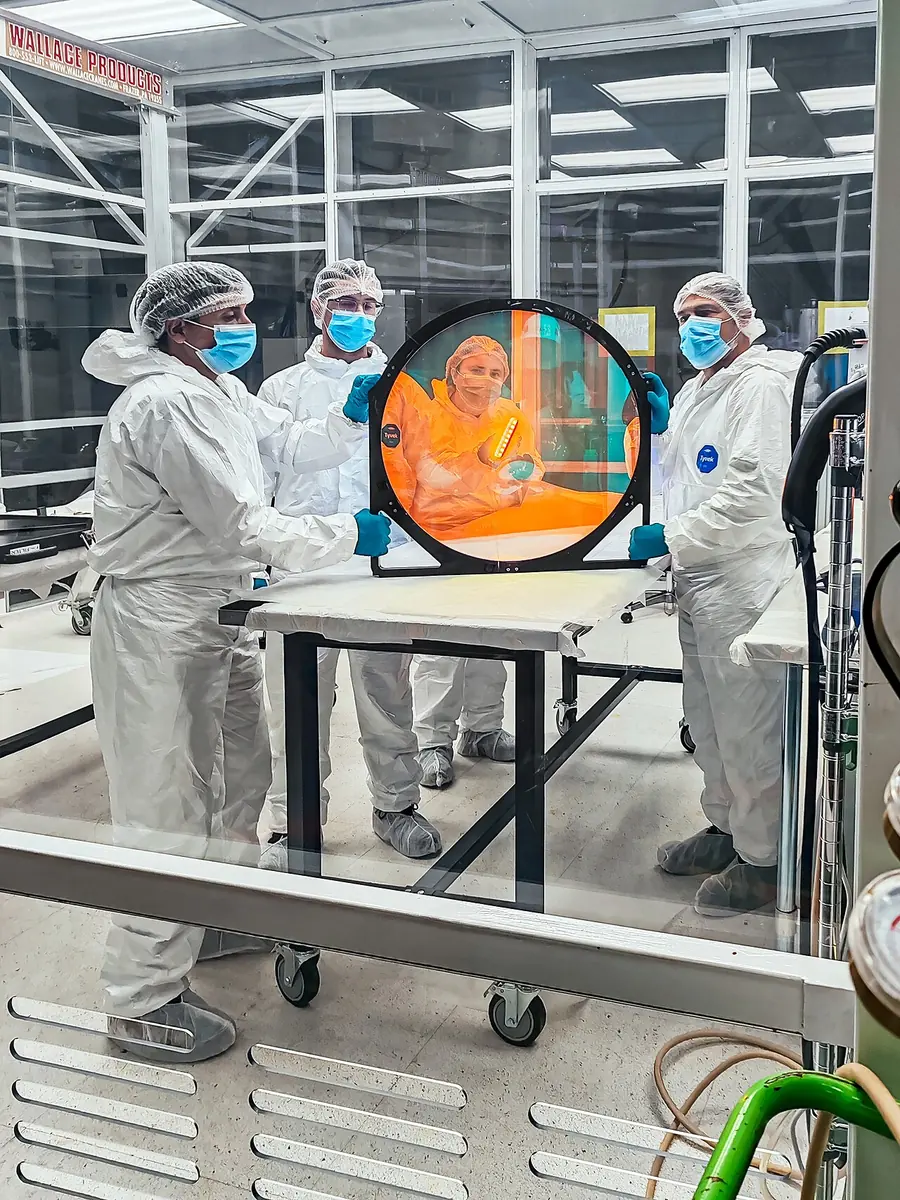
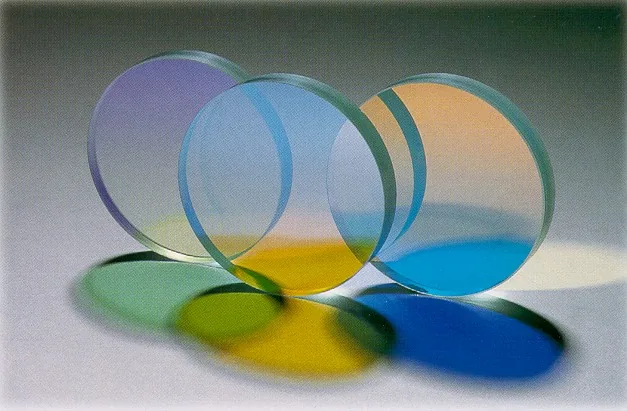
Almost all modern astro filters are interference filters: thin, precisely layered coatings on glass that transmit some wavelengths and reflect others. That is why they look brightly colored or mirror-like when tilted. The specifications that matter:
- Passband and bandwidth (FWHM). Where the filter transmits and how wide each window is, measured as the full width at half maximum in nanometers. A 3nm filter is far more selective than a 7nm filter.
- Peak transmission. The percentage of light passed in the window. Quality filters commonly quote around 90% or higher.
- Blocking depth. How strongly light outside the passband is rejected, often expressed as optical density (OD). OD4 means only about 1/10,000 of off-band light gets through.
- Size and format. 1.25″, 2″, or unmounted round sizes such as 31mm and 36mm. Larger sensors need larger filters to avoid vignetting.
The main filter types compared
| Filter type | What it passes | Best targets | Camera | Sky |
|---|---|---|---|---|
| UV/IR cut | Visible light only (roughly 400-700nm) | Everything, especially through refractors and lenses | OSC and modified DSLR/mirrorless | Any |
| Broadband light pollution (e.g. Optolong L-Pro) | Most of the visible spectrum with notches at sodium and mercury lines | Galaxies, star clusters, reflection nebulae | OSC, DSLR, mono luminance | Suburban, older-style lighting |
| Dual- or tri-band (e.g. L-eNhance, L-eXtreme, L-Ultimate) | Narrow windows at Ha and OIII (some include H-beta) | Emission nebulae, supernova remnants | OSC and DSLR | Suburban to city |
| Narrowband (Ha, OIII, SII) | One emission line each, typically 3-7nm | Emission nebulae, planetary nebulae | Monochrome | Any, including heavy light pollution and moonlight |
| LRGB | Luminance plus separate red, green and blue bands | Galaxies, clusters, true-color nebulae | Monochrome | Darker skies preferred |
| IR-pass and specialty | Near-infrared or specific bands | Planets and the Moon in poor seeing | Mono planetary cameras | Any |
UV/IR cut filters
Camera sensors respond to ultraviolet and near-infrared light that the eye cannot see. Refractors and camera lenses do not bring those wavelengths to the same focus as visible light, so unfiltered stars pick up bloated halos. A UV/IR cut filter removes them.
You need one when:
- You use a one-shot color astro camera whose protective window is not already IR-blocking. Check your camera’s documentation; manufacturers specify whether the window is plain anti-reflection or IR-cut.
- You have an astro-modified DSLR or mirrorless camera. A full modification removes the stock filter that blocks infrared and much of the deep-red hydrogen-alpha light; you then need a clip-in or front filter to restore sharp stars while keeping Ha.
Mono cameras usually rely on their filter set (LRGB or narrowband), which already blocks UV and IR.
Broadband light pollution filters
Broadband light pollution filters, such as the Optolong L-Pro, keep most of the visible spectrum but suppress the narrow emission lines of older streetlights. Optolong specifies the L-Pro’s spectrum as 380-750nm with off-band blocking at the sodium (589nm) and mercury (435nm and 578nm) lines, while keeping high transmission at H-beta, OIII, H-alpha and SII.
Because they pass so much of the spectrum, they are the only light pollution filters that suit galaxies, star clusters and reflection nebulae, which shine across the whole visible range rather than in a few lines.
The catch is modern lighting. White LED streetlights emit a broad, continuous spectrum, so there is no single line to notch out. As cities convert to LEDs, broadband filters do less, and some imagers find a plain UV/IR cut plus good gradient removal works as well. Our guide to the Bortle scale and imaging from light-polluted skies explains how sky brightness changes what is realistic.
Dual-band and tri-band filters for color cameras
Dual-band filters made one-shot color cameras and DSLRs into serious nebula tools under bright skies. They pass narrow windows around hydrogen-alpha (656.3nm) and oxygen III (500.7nm) and block nearly everything else, including most LED light pollution.
Optolong’s line shows the trade-offs (specifications as published by Optolong, November 2026):
| Filter | Bands | Bandwidth | Notes |
|---|---|---|---|
| L-eNhance | H-beta + OIII together, plus Ha | About 24nm (H-beta/OIII) and 10nm (Ha) | Tri-band; more forgiving, slightly more natural star color, less light pollution rejection |
| L-eXtreme | OIII and Ha | 7nm each | Darker background; Optolong-published material describes it as suited to fast systems such as f/2 RASA |
| L-Ultimate | OIII and Ha | 3nm each | Strongest rejection and contrast; Optolong says it is not suitable for fast focal-ratio systems |
Other brands, including Antlia, IDAS, Askar and ZWO, sell dual-band designs with similar trade-offs. Narrower is not automatically better: narrow filters need longer exposures, are more sensitive to fast optics, and give less star color.
Dual-band filters are for emission targets only. Use one on the Andromeda Galaxy and you mostly get stars on a dark background with a few red hydrogen regions.

Narrowband filters for monochrome cameras
Monochrome cameras use a separate filter for each emission line:
- Hydrogen-alpha (Ha), 656.3nm: the strongest signal in most emission nebulae.
- Oxygen III (OIII), 500.7nm: blue-green emission in supernova remnants, planetary nebulae and the cores of many nebulae.
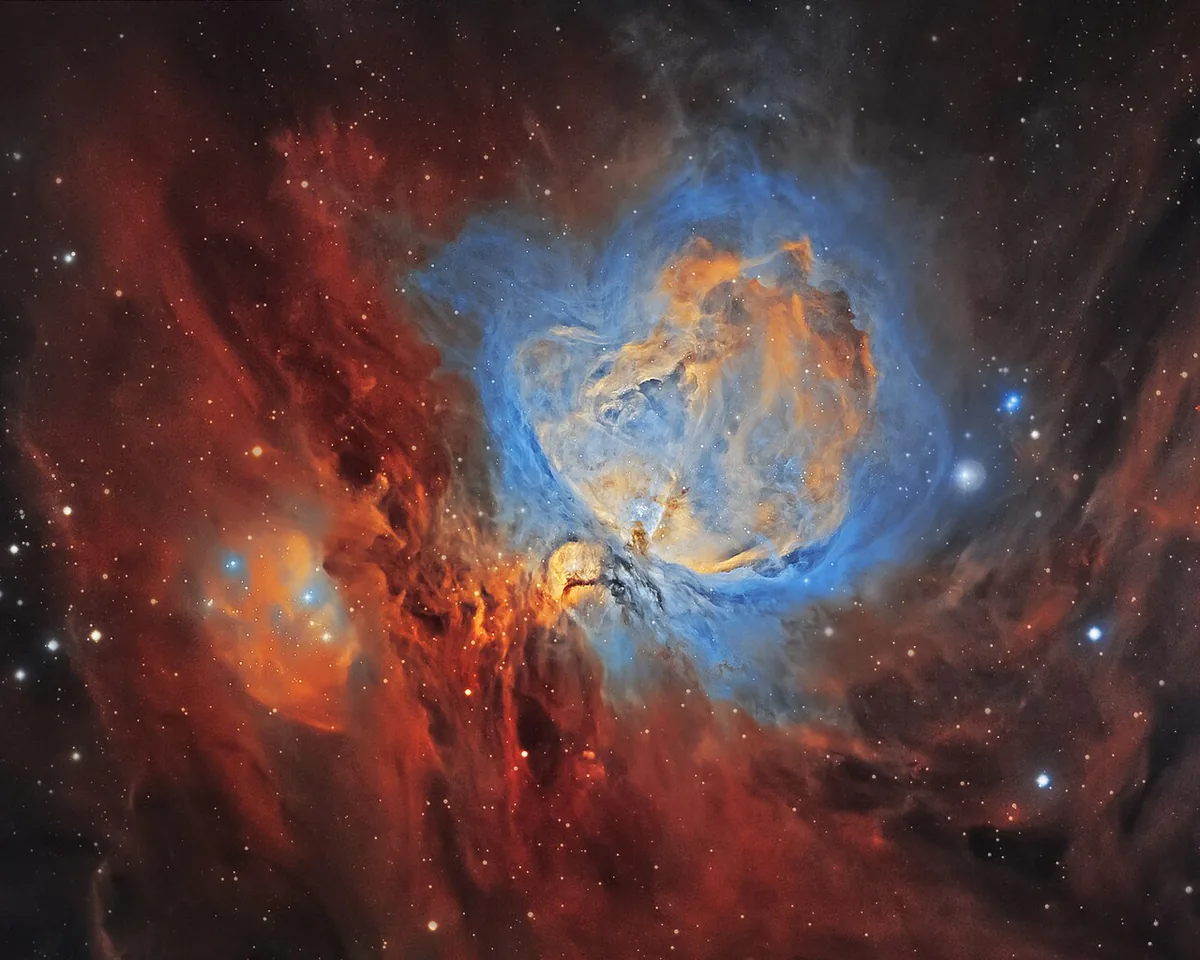
- Sulfur II (SII), 672.4nm: usually the faintest; used for the Hubble (SHO) palette.
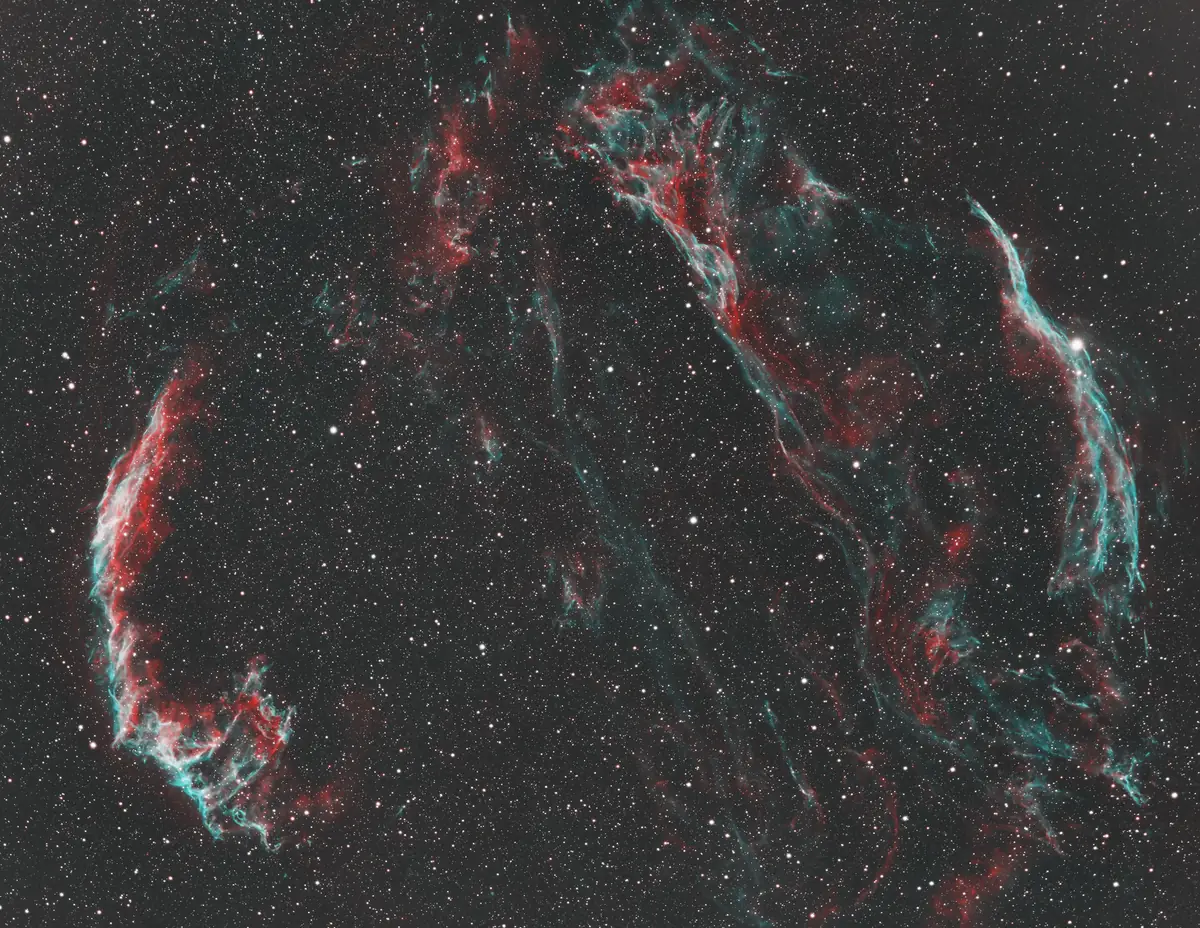
Common bandwidths run from about 3nm to 7nm. Narrower filters give higher contrast and smaller star halos, especially in moonlight, at a higher cost and longer exposure. The Veil Nebula in our post first pictures with a monochrome camera was captured through Optolong 7nm Ha and 6.5nm SII and OIII 36mm filters over 18 hours from Bortle 7 skies.
For palettes, processing and target choice, see our full guide to narrowband astrophotography and our comparison of mono vs color astro cameras.
Fast optics and bandpass shift
Interference filters are designed for light arriving nearly straight on. In a fast system, such as an f/2 RASA or a camera lens wide open, much of the light hits the filter at an angle. That shifts the passband toward shorter wavelengths and can push a narrow window partly off the emission line, cutting the signal.
That is why some narrowband filters are sold in fast-optimized (“high speed”) versions with the passband pre-shifted, and why very narrow 3nm filters often carry focal-ratio warnings. If you image at about f/3 or faster, check the manufacturer’s focal-ratio guidance before buying.
Filter size, vignetting and halos
- Size to the sensor. 1.25″ filters suit small sensors; APS-C and larger sensors generally need 36mm unmounted or 2″ filters, depending on how far the filter sits from the sensor and the focal ratio. Check the camera maker’s filter-size guidance.
- Spacing still matters. A filter adds optical path length (roughly one third of its thickness). Account for it when setting flattener or reducer backfocus.
- Halos around bright stars come from reflections between the filter, sensor window and other glass. Better coatings and changing the filter’s distance from the sensor can reduce them.
- Parfocality. Filters from the same set are usually close to parfocal, but not always. Use per-filter focus offsets, as covered in our guide on how to use a Bahtinov mask and HFR autofocus.
How to choose: a quick decision guide
- Imaging galaxies or clusters with a color camera? Start with a UV/IR cut (if needed). Add a broadband light pollution filter only if your local lighting is mostly sodium or mercury.
- Imaging emission nebulae with a color camera from a suburb or city? A dual- or tri-band filter is the single biggest upgrade. Start with a 7nm-class filter for a balance of contrast and forgiveness.
- Using a mono camera? Buy Ha first, then OIII, then SII. Add LRGB for galaxies and true-color work.
- Imaging at f/3 or faster? Look specifically for fast-optimized filters.
- Imaging the Sun? None of these filters are safe for solar viewing or imaging. Use only purpose-built solar filters that cover the full aperture.
Common filter mistakes
- Using a dual-band filter on galaxies and wondering why the color is gone.
- Buying the narrowest filter first for a fast system or a sky that is already fairly dark.
- Undersized filters on a large sensor, causing dark corners that flats cannot fully fix.
- Skipping flats after changing filters. Each filter collects its own dust; take flats per filter.
- Expecting a filter to fix gradients entirely. Filters reduce light pollution; they do not remove it. Gradient removal is still part of processing.
Frequently asked questions
Not always. Under dark skies, a color camera with a UV/IR cut filter (or an IR-cut window) is enough for most targets. Filters become valuable under light pollution, for emission nebulae, and with monochrome cameras that need separate color or narrowband filters.
A dual-band filter passes two narrow windows (usually Ha and OIII) at the same time, so a color camera records both in one exposure. Narrowband filters pass a single emission line each and are used one at a time with a monochrome camera.
Broadband light pollution filters work poorly against white LEDs because LEDs emit a broad continuous spectrum. Dual-band and narrowband filters still work well because they block nearly everything except the nebula's emission lines.
It is not recommended. Galaxies emit across the whole spectrum, so a dual-band filter blocks most of their light. Use a UV/IR cut or broadband filter for galaxies and save the dual-band filter for emission nebulae.
6-7nm filters are a good balance of contrast, price and forgiveness for most setups. 3nm filters give more contrast in heavy light pollution and moonlight but cost more, need longer exposures and are more sensitive to fast optics.
Filters add optical path length and may not be perfectly parfocal with each other. Refocus after changing filters or store per-filter focus offsets in your capture software.