
Quick answer: A DSLR or mirrorless camera is the better first astro camera if you already own one: it works with lenses, needs no computer, and does a fine job on wide-field targets. A dedicated cooled astronomy camera is better for serious deep-sky imaging because it holds a fixed sensor temperature (so dark frames match), has no factory infrared-cut filter blocking hydrogen-alpha light, and produces cleaner data over long sessions. Choose a one-shot-color (OSC) astro camera for simplicity, or a monochrome camera with filters for maximum quality and narrowband flexibility.
As an Amazon Associate, Midwest Astronomy earns from qualifying purchases.
The camera debate comes up in every astrophotography forum, and most of the answers are “it depends.” This guide makes the trade-offs concrete: what physically differs between the two kinds of camera, how those differences show up in your images, and which models make sense at each stage.
The short comparison
| Feature | DSLR / mirrorless | Dedicated cooled astro camera |
|---|---|---|
| Sensor cooling | None; sensor warms during long sessions | Regulated thermoelectric (TEC) cooling to a set temperature |
| Dark frame matching | Hard; temperature drifts through the night | Easy; build a reusable dark library at fixed temperatures |
| Hydrogen-alpha (656.3nm) response | Reduced by the stock IR-cut filter unless astro-modified | Full sensor response; no factory IR-cut filter on most models |
| Color | Always color (Bayer filter) | Color (OSC) or monochrome with filters |
| Computer needed | No; intervalometer is enough | Yes; laptop, mini PC or a controller such as ASIAIR |
| Power | Internal battery or dummy battery | 12V supply for the cooler, plus USB |
| Use beyond astro | Daytime photography, video, nightscapes | Astronomy only |
| Lens compatibility | Native lenses and adapters | Usually used on telescopes; lens adapters exist |
| Best for | Beginners, nightscapes, wide-field tracking | Long deep-sky integrations, narrowband, galaxies |
Why sensor temperature matters so much
Every camera sensor generates thermal signal (dark current) that roughly doubles with every few degrees of temperature rise. In a long sequence on a warm night, a DSLR or mirrorless sensor gradually heats up, so frame 1 and frame 100 contain different amounts of thermal noise and different hot pixel patterns.
Dark calibration frames work by subtracting that thermal signal. They only work well if the darks match the lights in exposure, gain or ISO, and temperature. With a regulated cooled camera you set, say, -10°C, and every light and dark matches exactly. You can shoot a dark library once and reuse it for months.
With a DSLR you can still shoot darks, but you are always approximating. Many DSLR imagers rely on dithering (small random shifts between frames) plus a bad-pixel map instead of darks, and that works well enough for wide-field work.
Cold Midwestern winters help uncooled cameras somewhat, since a sensor starts much cooler on a 15°F night than on a humid July evening. But the temperature still drifts, and summer is prime season for the Milky Way and nebulae.
Hydrogen-alpha: the hidden difference
Many of the most popular deep-sky targets, including the North America Nebula, Rosette Nebula, Heart and Soul nebulae and Barnard’s Loop, glow mostly in hydrogen-alpha (H-alpha) light at 656.3nm, a deep red.
Ordinary cameras place a filter in front of the sensor to block infrared and shape color for daylight photography. That filter also cuts a large share of H-alpha. The result is that a stock camera records emission nebulae faintly, and some targets barely show up at all.
You have three options:
- Astro-modify the camera by replacing or removing the filter (third-party services do this). This voids the warranty and gives daytime photos a red/pink cast unless you add a clip-in or lens filter.
- Buy a factory astro body. Canon’s EOS Ra and Nikon’s D810A were built for this but have been discontinued, so they are only available used.
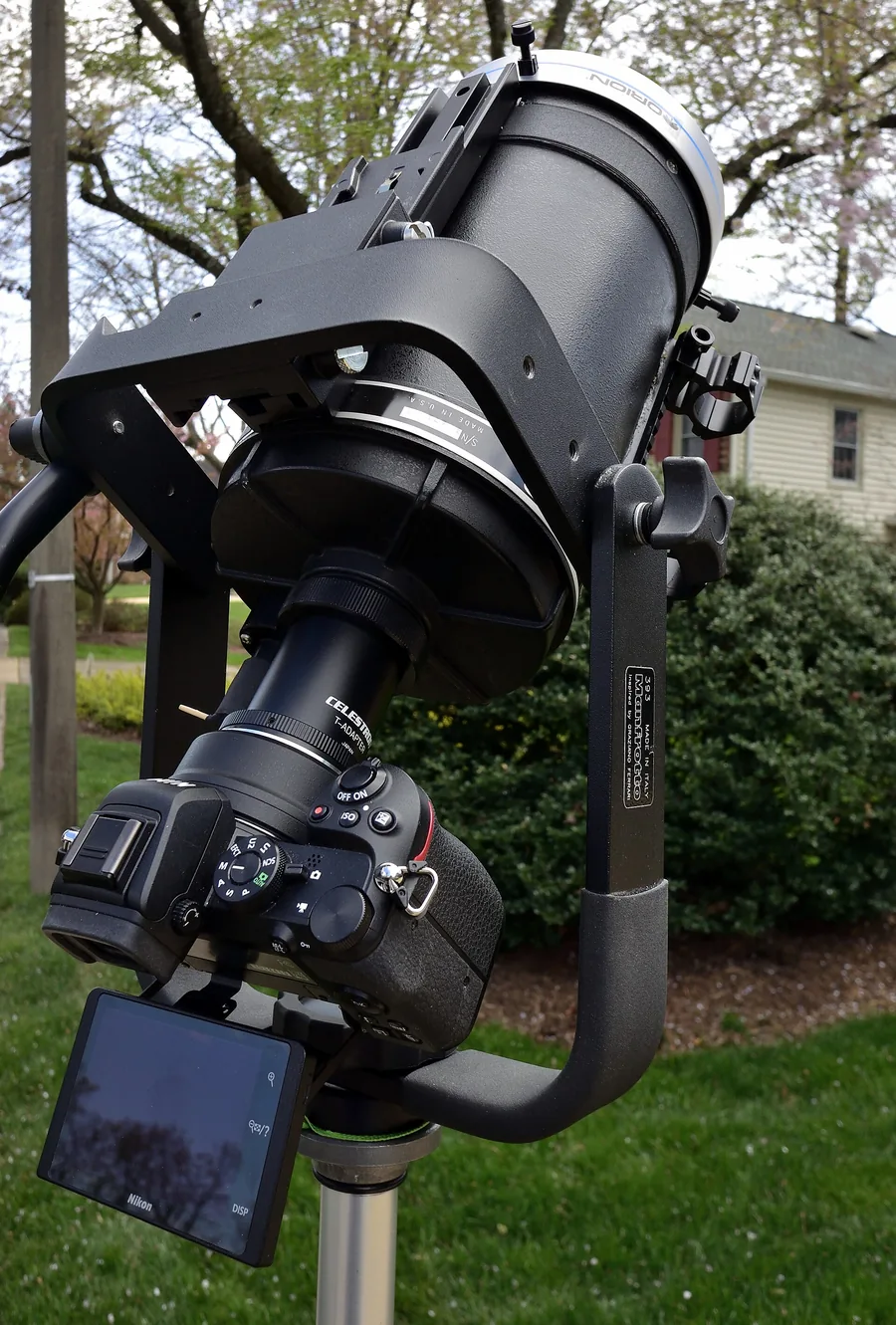
- Use a dedicated astro camera, which has no factory IR-cut filter on most models. For one-shot-color astro cameras on refractors you typically add a UV/IR-cut or light-pollution filter yourself.
One-shot color vs monochrome
Once you go dedicated, the next decision is OSC or mono.
One-shot color (OSC) cameras have a Bayer matrix of red, green and blue filters over the pixels, just like a DSLR. Each exposure produces a color image. They are simpler: no filter wheel, no filter changes, one set of calibration frames. With a dual-band filter such as the Optolong L-eXtreme or Optolong L-eNhance, an OSC camera can isolate H-alpha and oxygen III light and fight light pollution surprisingly well.
Monochrome cameras have no Bayer matrix. Every pixel records every photon that reaches it, and you choose the color with filters: luminance, red, green and blue for natural color, or H-alpha, oxygen III and sulfur II for narrowband. Mono delivers the most signal per pixel in narrowband because, with an OSC camera behind an H-alpha filter, only the red-filtered pixels (one in four) are collecting useful light.
The trade-offs are cost and complexity: mono needs a filter wheel, a set of filters, separate flats for each filter, and more capture time to collect every channel.
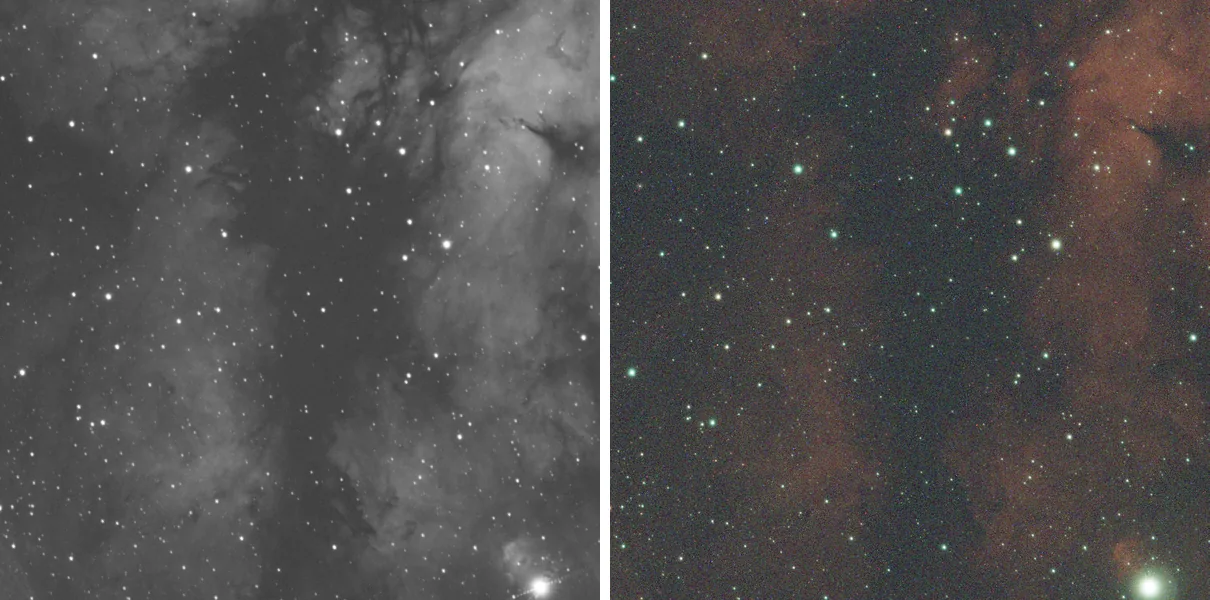
The comparison above, from our first monochrome camera post, shows single 6-minute subs of the same field near Sadr taken the same night at nearly the same focal length. The mono camera with a dedicated H-alpha filter shows much smoother, more detailed nebulosity than the color camera with a dual-band filter in a single frame. Stacking narrows the gap, but it shows why many imagers eventually move to mono.
| OSC astro camera | Mono astro camera | |
|---|---|---|
| Setup complexity | Low | Higher: filter wheel, filters, per-filter flats |
| Narrowband efficiency | Lower (Bayer matrix) | Highest |
| Broadband color | One step | Combine L, R, G, B channels |
| Best for | Beginners, limited clear nights, galaxies and clusters | Narrowband, bright skies, maximum detail |
Pixel size, sensor size and image scale
Matching the camera to the telescope matters more than megapixels. Image scale (how much sky each pixel covers) is:
Image scale (arcsec/pixel) = 206.265 × pixel size (µm) ÷ focal length (mm)
For deep-sky imaging under typical backyard seeing, many imagers aim for roughly 1–2.5 arcseconds per pixel. A 3.76µm pixel on a 400mm telescope gives about 1.9″/px, which suits average seeing well. Very small pixels on long focal lengths “oversample,” spreading light across more pixels than the atmosphere can resolve; very large scales “undersample,” making stars blocky.
Sensor size controls field of view. An APS-C sensor frames large nebulae on short refractors, while a 1-inch square sensor suits smaller targets and is more forgiving of field flatness at the edges.
Recommended cameras by tier
These are current, widely used models. Check each manufacturer’s spec page for the latest details, since sensors and cooling ratings vary by revision.
If you are using a DSLR or mirrorless body
Use what you have. Any recent full-frame or APS-C body with clean high-ISO performance and RAW output is a capable starter. If you are buying, mirrorless bodies such as the Sony a7 IV, Nikon Z6III or Canon EOS R6 Mark II offer bright electronic viewfinders and live view magnification that make focusing on stars easier. For a budget start, a used or entry-level body like the Canon EOS Rebel T7 is popular because it is easy to have astro-modified.
Entry dedicated: uncooled planetary and EAA cameras
Uncooled cameras with small pixels and fast frame rates are built for planetary, lunar and solar imaging, and many double as guide cameras or live-stacking cameras.
- ZWO ASI585MC: Sony IMX585 sensor, 2.9µm pixels, popular for planets and the moon.
- ZWO ASI662MC: a smaller, budget-friendly planetary option.
Mid-range cooled OSC
- ZWO ASI533MC Pro: a 1-inch square Sony IMX533 sensor (3008 × 3008, 3.76µm pixels) with regulated cooling. Its square format and small sensor make it easy to get flat corners on small refractors.
- Player One Poseidon-C Pro and QHY268C: APS-C cooled color cameras built around the Sony IMX571 sensor.
APS-C cooled flagships
- ZWO ASI2600MC Pro: Sony IMX571 APS-C sensor (6248 × 4176, 3.76µm pixels) with a 16-bit ADC and regulated cooling. Probably the most common “do-everything” deep-sky color camera today.
- ZWO ASI2600MM Pro: the monochrome version of the same platform, paired with a filter wheel and narrowband filters for maximum flexibility.
Controlling a dedicated camera
You will need something to run it. Options include a Windows laptop or mini PC running N.I.N.A. (free) or SharpCap, or a dedicated controller such as the ZWO ASIAIR Plus, which runs capture, guiding, plate solving and polar alignment from a phone or tablet app. ASIAIR works best within ZWO’s ecosystem, so check camera and accessory compatibility before mixing brands.
Which should you choose?
Choose a DSLR or mirrorless camera if:
- You already own one, or you also want a daytime camera.
- You mainly shoot the Milky Way, nightscapes and wide-field targets with lenses.
- You want to travel light without a laptop.
Choose a cooled OSC astro camera if:
- You image mostly through a telescope and want clean, repeatable data.
- You want strong results on emission nebulae without modifying a camera.
- You have limited clear nights and want color in every frame.
Choose a cooled mono camera if:
- You image from light-polluted skies and want to focus on narrowband.
- You are comfortable with a filter wheel, more calibration and longer projects.
- You want the most detail and flexibility from every hour of data.
Whatever you choose, the mount and polar alignment still matter more than the camera. Our polar alignment tutorial and beginner’s guide cover the rest of the rig.
Frequently asked questions
For deep-sky imaging through a telescope, usually yes. Regulated cooling makes calibration frames match exactly, and most astro cameras have no factory IR-cut filter, so they record hydrogen-alpha nebulae much better. A DSLR or mirrorless camera is more versatile and is still an excellent choice for wide-field and nightscape work.
Not for galaxies, star clusters or the Milky Way. Modification helps a lot with red emission nebulae because the stock filter blocks much of the hydrogen-alpha light at 656.3nm. Modification voids the warranty and changes daytime color unless you add a corrective filter.
Most people do best starting with a one-shot-color camera because it needs no filter wheel and produces color in every frame. Mono cameras deliver more detail and are far more efficient for narrowband, but they add cost, complexity and capture time.
Yes. Dedicated astro cameras have no screen or controls, so they are run from a laptop or mini PC with software like N.I.N.A. or SharpCap, or from a controller such as the ZWO ASIAIR. They also need 12V power for the cooler.
Calculate image scale as 206.265 times pixel size in microns divided by focal length in millimeters. For typical backyard seeing, roughly 1 to 2.5 arcseconds per pixel works well for deep-sky imaging.