
Quick answer: For most people starting deep-sky astrophotography, a small apochromatic refractor (about 50-80 mm aperture, 250-500 mm focal length) is the best telescope type: it is light, needs no collimation and gives sharp stars on a modest mount. Imaging Newtonians give more aperture and speed per dollar but need collimation and a coma corrector. SCTs and EdgeHD-type designs suit small galaxies, planets and the Moon, but demand a heavy-duty mount and excellent guiding.
As an Amazon Associate, Midwest Astronomy earns from qualifying purchases.
There is no single best telescope for astrophotography. There is a best telescope for your targets, your mount, your sky and your patience. The three classic families, refractors, reflectors (mainly Newtonians) and catadioptrics (mainly Schmidt-Cassegrains), make very different trade-offs in focal length, speed, weight and maintenance. This guide compares them for imaging, not visual use, where the priorities are different.
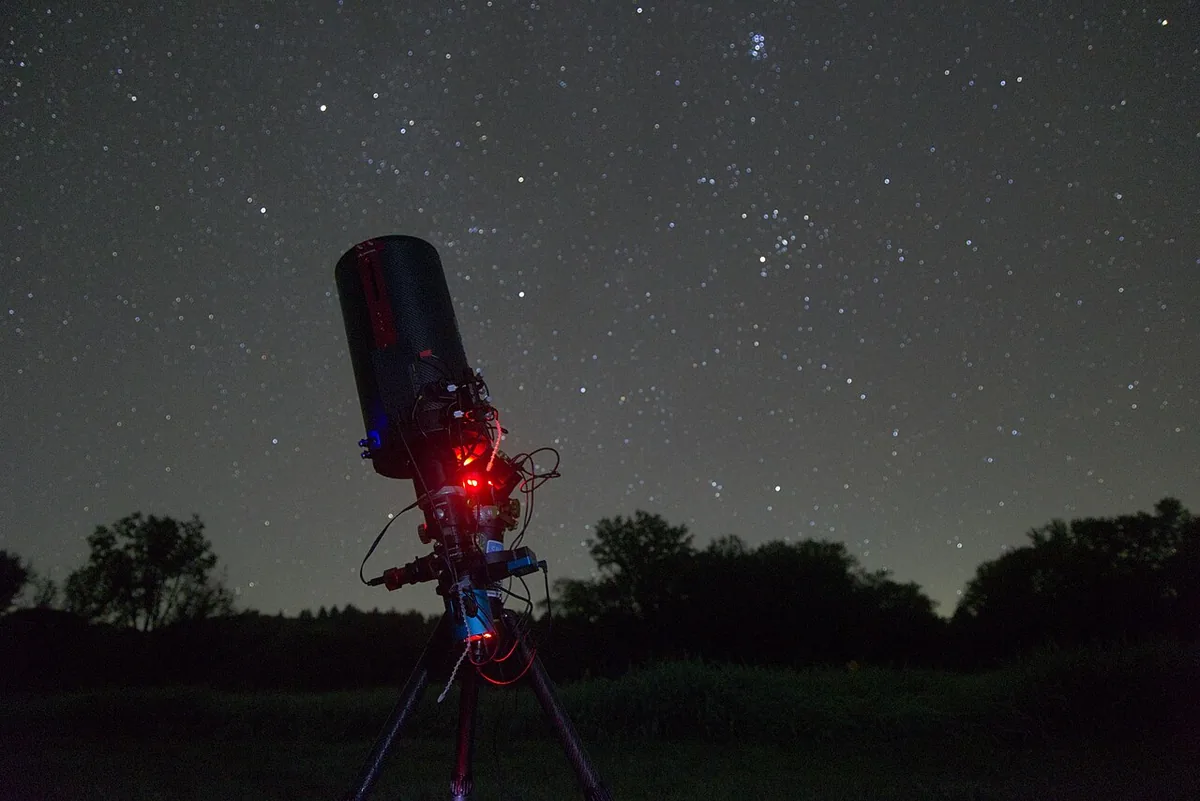
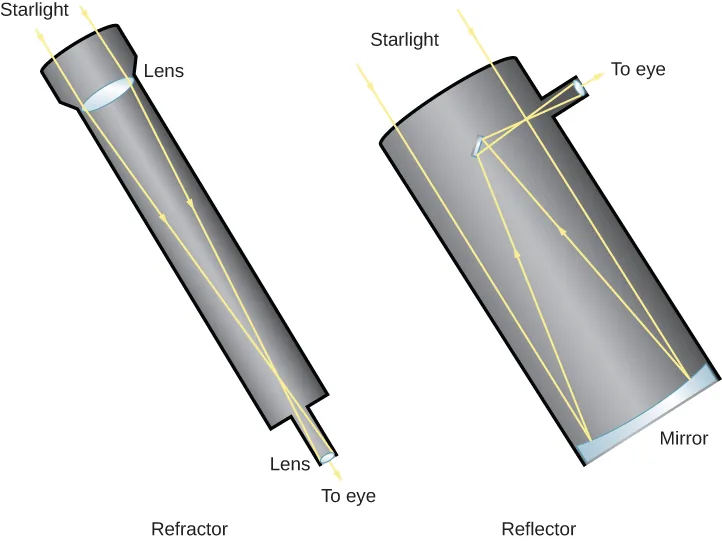
How the three designs work
- Refractors use lenses to bend light to a focus. Imaging refractors are apochromatic (APO): they use extra-low-dispersion (ED) glass, often in doublets, triplets or four-element Petzval designs, to bring all colors to the same focus. A field flattener or a built-in flat-field design keeps stars round across the sensor.
- Newtonian reflectors use a parabolic primary mirror and a flat diagonal secondary that sends light out the side of the tube. Imaging Newtonians are short and fast (around f/4-f/5) and need a coma corrector for round stars at the edges.
- Schmidt-Cassegrains (SCTs) fold a long focal length into a short tube with a spherical primary mirror, a convex secondary and a thin corrector plate at the front. Standard SCTs have a curved field; aplanatic designs such as Celestron’s EdgeHD add a corrector for a flat field. Related designs include the Ritchey-Chrétien (RC), which uses two hyperbolic mirrors, and fast Schmidt astrographs like the Celestron RASA, which put the camera at prime focus.
Refractor vs reflector vs SCT for imaging
| Factor | APO refractor | Imaging Newtonian | SCT / EdgeHD |
|---|---|---|---|
| Typical imaging focal length | 250-600 mm | 400-1000 mm | 1400-2800 mm (with or without reducer) |
| Typical focal ratio | f/4.5-f/7 | f/3.5-f/5 | f/7-f/10 (f/2 with Fastar/HyperStar-type setups) |
| Aperture per dollar | Lowest | Highest | High |
| Weight for aperture | Heavy per inch, light overall at small sizes | Moderate, long tube catches wind | Compact, but heavy for the mount |
| Collimation | None for the user | Regular | Occasional (secondary only) |
| Cool-down | Fast | Moderate (open tube) | Slow (closed tube) |
| Diffraction spikes | None | Yes, from secondary vanes | None (round stars) |
| Dew | Moderate; dew shield helps | Low on mirror, high on secondary in damp air | High; corrector plate dews quickly |
| Field flatness | Flat with flattener or Petzval | Flat with coma corrector | Curved (standard SCT); flat (EdgeHD with reducer) |
| Best targets | Wide-field nebulae, large galaxies, clusters | Nebulae and galaxies, fast integration | Small galaxies, planetary nebulae, planets, Moon |
| Mount demand | Low to moderate | Moderate to high | High |
| Beginner friendliness | Best | Good once collimation is learned | Hardest for deep-sky |
Why focal length and image scale matter more than design
The design matters less than what it does to your image scale. Image scale, in arcseconds per pixel, is:
Image scale = 206.265 x pixel size (µm) / focal length (mm)
Typical backyard seeing across much of the US, the Midwest included, is often in the 2-4 arcsecond range, which means most deep-sky imaging works best around 1-2.5 arcseconds per pixel. With a common 3.76 µm pixel camera:
| Focal length | Image scale with 3.76 µm pixels | What it suits |
|---|---|---|
| 250 mm | about 3.1″/px | Wide fields, large nebulae, Milky Way regions |
| 400 mm | about 1.9″/px | Most nebulae, large galaxies such as M31 and M33 |
| 600 mm | about 1.3″/px | Mid-size galaxies, planetary nebulae, nebula details |
| 1422 mm | about 0.55″/px | Small galaxies; oversampled unless seeing is good or you bin 2×2 |
| 2032 mm | about 0.38″/px | Planets and Moon with fast video; heavily oversampled for deep sky |
Longer focal length also magnifies every tracking error. A mount that guides at 0.8″ RMS looks perfect at 3″/px and soft at 0.5″/px. If you are still on a star tracker or entry-level mount, choose the telescope that matches the mount, not the one you will grow into.
Refractors: the default choice for deep-sky beginners
A small APO is the most forgiving way to start imaging. There is no mirror to collimate or cool, there are no diffraction spikes unless you add them, and short focal lengths hide small guiding and polar alignment errors.
Examples of current imaging refractors (manufacturer specs, as of November 2026):
- The William Optics RedCat 51 WIFD is a 51 mm, 250 mm f/4.9 four-element Petzval with a 48 mm image circle and no flattener required. William Optics lists the OTA at 1.77 kg.
- The Sky-Watcher Evolux 62ED is a 62 mm, 400 mm f/6.45 ED doublet. With its matching 0.9x reducer/flattener it becomes 360 mm at f/5.8.
- Larger 72-100 mm ED and triplet refractors at 400-700 mm cover the middle ground for galaxy season.
Trade-offs to know:
- Aperture is expensive. Each step up in refractor aperture costs far more than the same step in a reflector.
- Doublets vs triplets. ED doublets can show slight blue halos on bright stars, especially with one-shot color cameras. Triplets and good four-element designs control it better. Narrowband imaging hides most of the difference.
- Backfocus and tilt. Flatteners need the right spacing to the sensor. Our elongated stars troubleshooting guide covers tilt and spacing errors.
Imaging Newtonians: most aperture and speed per dollar
A fast Newtonian gathers far more light than a small refractor and covers a similar field to a mid-size APO. That shortens integration time noticeably, which matters under light-polluted skies.
Example (manufacturer specs, as of November 2026): the Sky-Watcher Quattro 150P is a 150 mm, 600 mm f/4 imaging Newtonian. Sky-Watcher USA lists its included coma corrector/reducer as giving 518 mm at f/3.45, suited to APS-C and smaller sensors, and the OTA at 5.7 kg. Sky-Watcher’s 130 mm and 200 mm imaging Newtonians follow the same idea.
What you sign up for:
- Collimation. Fast mirrors need accurate collimation, checked before most sessions. A laser collimator or a Cheshire and an autocollimator are part of the kit.
- Coma correction. Without a coma corrector, stars become comet-shaped toward the edges. Correctors have strict backfocus requirements.
- Tube flexure and focuser sag. Stock focusers and thin tubes can flex under a heavy camera and filter wheel. Many owners upgrade the focuser.
- Wind and balance. Long tubes catch wind and are front-heavy with a camera at the focuser, which sits on the side of the tube.
- Diffraction spikes. Some love them; others do not. They come with the design.
SCTs and EdgeHD: long focal length in a short tube
Schmidt-Cassegrains are compact, rugged and versatile, and they dominate amateur planetary imaging. For deep sky, they are the most demanding of the three families.
Example (manufacturer specs, as of November 2026): Celestron lists the EdgeHD 8 at 203.2 mm aperture, 2032 mm focal length, f/10 native and f/7 with the dedicated reducer, with a 31% central obstruction by diameter and a 6.35 kg tube. The standard Celestron C8 shares the 8-inch f/10 format without the flat-field corrector.
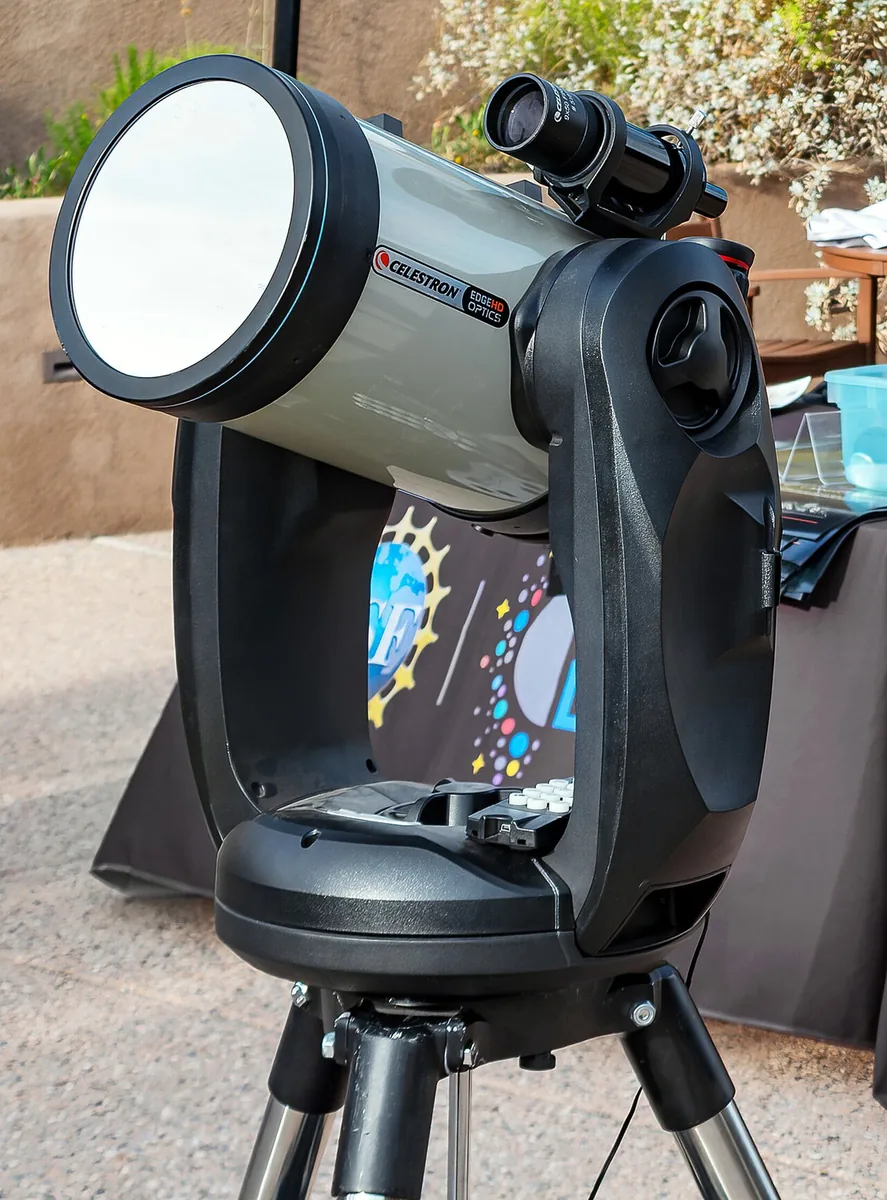
What makes SCTs harder for deep sky:
- Image scale. Even at f/7, most cameras are oversampled. Plan on 2×2 binning or cameras with larger pixels.
- Guiding. At 1400-2000 mm, you need sub-arcsecond guiding. An off-axis guider is strongly recommended to avoid differential flexure and mirror shift. Start with our PHD2 guiding tutorial.
- Mirror shift. SCTs focus by moving the primary mirror. Mirror locks or clutches (EdgeHD has them) plus an external focuser reduce image shift during long exposures.
- Dew. The front corrector is a dew magnet. A dew shield and heater strip are mandatory in most Midwest nights; see our cold weather guide for heater tips.
- Slow speed. f/7-f/10 needs much more exposure per sub and more total time than an f/4 Newtonian.
Where SCTs shine: small galaxies in spring, planetary nebulae, and lucky imaging of planets and the Moon, where long focal length is exactly what you want.
Fast Schmidt astrographs: the RASA option
Celestron’s Rowe-Ackermann Schmidt Astrograph puts the camera in front of the corrector at prime focus. Celestron lists the RASA 8 at 203 mm, 400 mm and f/2.0, optimized for a 22 mm image circle with a usable field of 32 mm, 29 mm of backfocus from the threaded collar, and a 7.7 kg tube. At f/2, an hour of data can show what would take many hours at f/7, but the system is sensitive to tilt and spacing, the camera body blocks part of the aperture, and very narrow filters shift their bandpass at fast focal ratios, so f/2-rated filters are needed for narrowband.
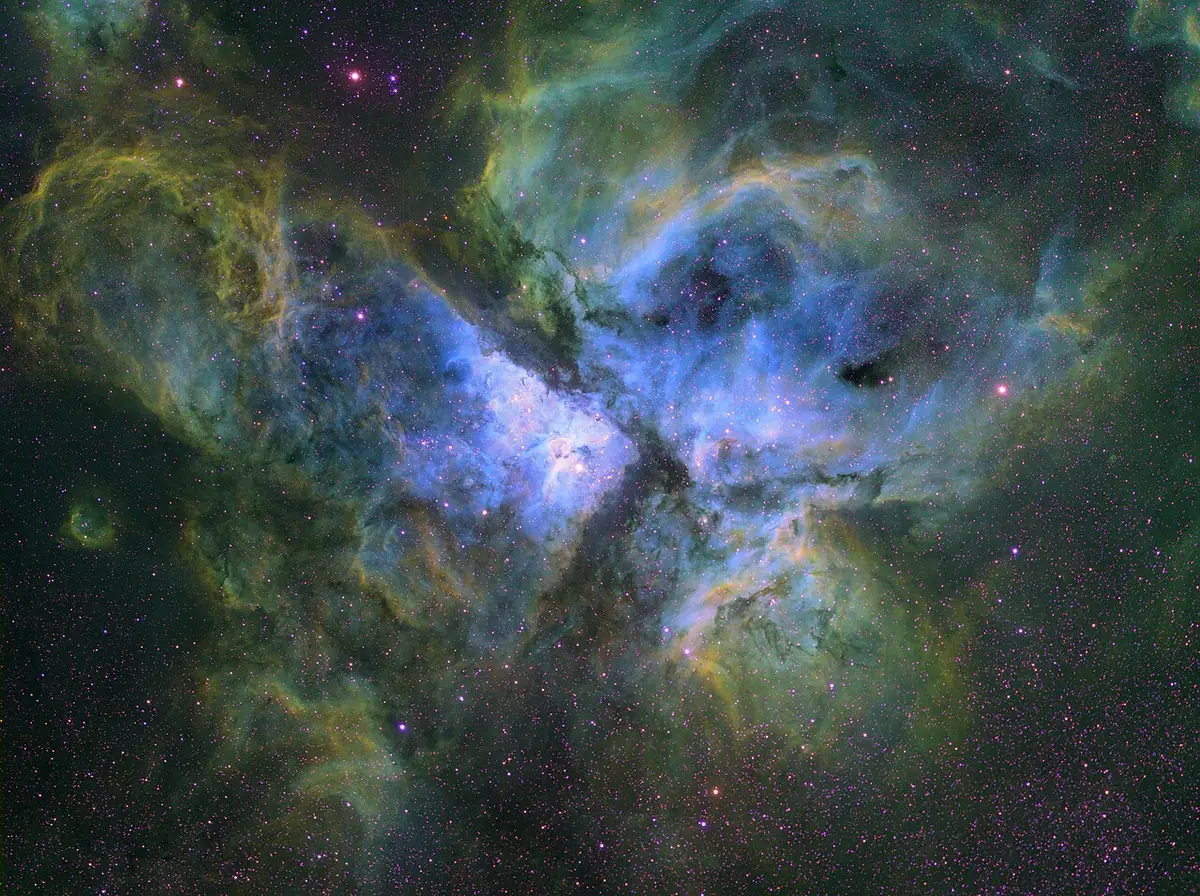
Mount capacity: the hidden deciding factor
The telescope you can mount well beats the telescope you want. A common rule of thumb is to keep the imaging payload (telescope, camera, filter wheel, guide scope, focuser and dew straps) at roughly half to two-thirds of a mount’s rated capacity, less for long focal lengths. A 6.35 kg EdgeHD 8 tube turns into a 9-11 kg payload once it has a reducer, off-axis guider, camera and dew heater. A 1.77 kg RedCat with a small camera works on a star tracker.
Our astro camera vs DSLR guide covers how the camera side of that payload adds up.
Which telescope type should you choose?
- New to deep sky, on a small or mid-size mount: a 50-80 mm APO refractor at 250-500 mm. Best success rate and least maintenance.
- Light-polluted backyard, want faster results on nebulae and galaxies: a 130-200 mm imaging Newtonian at f/4-f/5 on a solid mount, plus collimation tools.
- Galaxy season and planets, with a heavy mount and good guiding: an EdgeHD or RC at 1000-2000 mm, preferably with an off-axis guider.
- Maximum speed for wide nebulae with a cooled camera: a RASA-style f/2 astrograph, accepting more fussiness about tilt and filters.
- One scope for everything: none exists. Many imagers end up with a short refractor for wide fields and a longer reflector or SCT for small targets.
If you are still choosing your first full kit, start with the astrophotography for beginners guide and plan polar alignment with our polar alignment guide before adding focal length.
Frequently asked questions
A small apochromatic refractor is easier for beginners because it needs no collimation, cools quickly and works on lighter mounts. An imaging Newtonian reflector gives more aperture and speed for the money, which shortens integration time, but needs regular collimation, a coma corrector and a sturdier mount.
They can be, but they are the hardest to start with. Long focal lengths of 1400-2000 mm need a heavy mount, sub-arcsecond guiding, ideally an off-axis guider, and a reducer or flat-field design such as EdgeHD. SCTs are excellent for small galaxies, planetary nebulae, planets and the Moon.
Roughly 250-500 mm is the sweet spot. It frames many large nebulae and galaxies, gives an image scale of about 1.5-3 arcseconds per pixel with common cameras, and hides small tracking and polar alignment errors that would be obvious at longer focal lengths.
Fast parabolic mirrors produce coma, which stretches off-axis stars into comet shapes toward the edges of the frame. A coma corrector placed at the correct distance from the sensor flattens the field and keeps stars round to the corners.
For imaging, an apochromatic refractor is strongly preferred. Achromats focus blue and red light at different points, producing purple halos around stars. They can work with narrowband filters, but an ED or triplet APO gives much better color images.
A common rule of thumb is to keep the full imaging payload at about half to two-thirds of the mount's rated capacity, and lower for long focal lengths. Include the camera, filter wheel, guide scope, focuser, rings and dew equipment in the total.