
Quick answer: Choose a star tracker if you shoot with a camera and lenses up to roughly 200mm and value portability; trackers carry about 5 kg and fit in a backpack. Choose an equatorial mount (a GoTo German equatorial or a strain-wave mount) once you add a telescope, a guide camera or a cooled astro camera, or want focal lengths above about 300mm. Upgrade when payload, frequent star trailing, or lack of GoTo and dual-axis guiding is holding you back.
As an Amazon Associate, Midwest Astronomy earns from qualifying purchases.
Both devices do the same basic job: they rotate your camera around an axis parallel to Earth’s, at the sidereal rate of about 15 arcseconds per second, so the stars stay put during long exposures. The difference is how much weight they carry, how precisely they track, and how much they help you find and hold targets. This guide compares the two honestly, with specs checked against Sky-Watcher, iOptron and ZWO documentation as of November 2026, and lays out the specific signs that it is time to move up.
What a star tracker is (and is not)
A star tracker is a compact, single-axis equatorial drive. You polar align it, mount a camera on a ball head or a declination bracket, and the right ascension (RA) motor turns at sidereal speed. Most trackers have no declination motor and no GoTo; you point the camera by hand.
The current mainstream options all share the same rated capacity:
- Sky-Watcher Star Adventurer 2i: 5 kg (11 lb) maximum payload, 1 kg mount head, runs on four AA batteries or 5V USB, built-in Wi-Fi app control and an illuminated polar scope. It supports single-axis (RA) autoguiding.
- iOptron SkyGuider Pro: 5 kg (11 lb) balanced payload with the declination bracket (counterweight excluded), about 1 kg with its built-in rechargeable Li-Poly battery, an ST-4 guide port and an illuminated AccuAlign polar scope. A version with iOptron’s iPolar electronic polar scope is also sold.
- Sky-Watcher Star Adventurer GTi: a hybrid. It is still rated for 5 kg (11 lb), but it has motors on both axes, GoTo through the SynScan Pro app, Wi-Fi and USB control, and ST-4 or USB guiding on both axes. The mount head weighs about 2.6 kg.
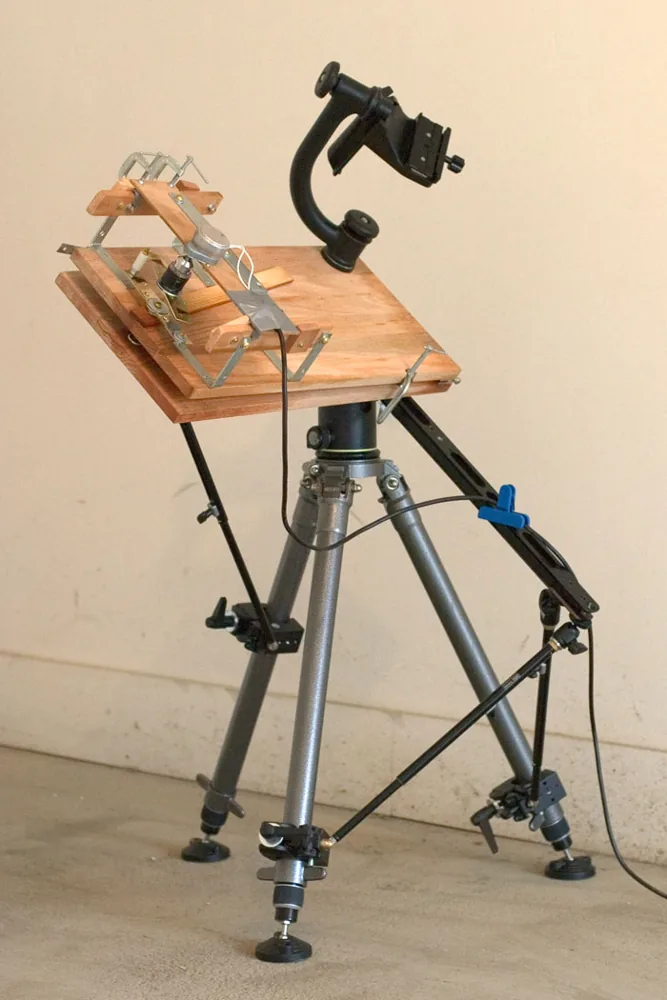
The concept is older than any of these products. A barn door tracker, two boards hinged on an axis pointed at the pole and opened by a screw, does the same thing by hand or with a small motor. Commercial trackers simply replace the screw with a worm gear and a servo motor and add a polar scope.
What an equatorial mount adds
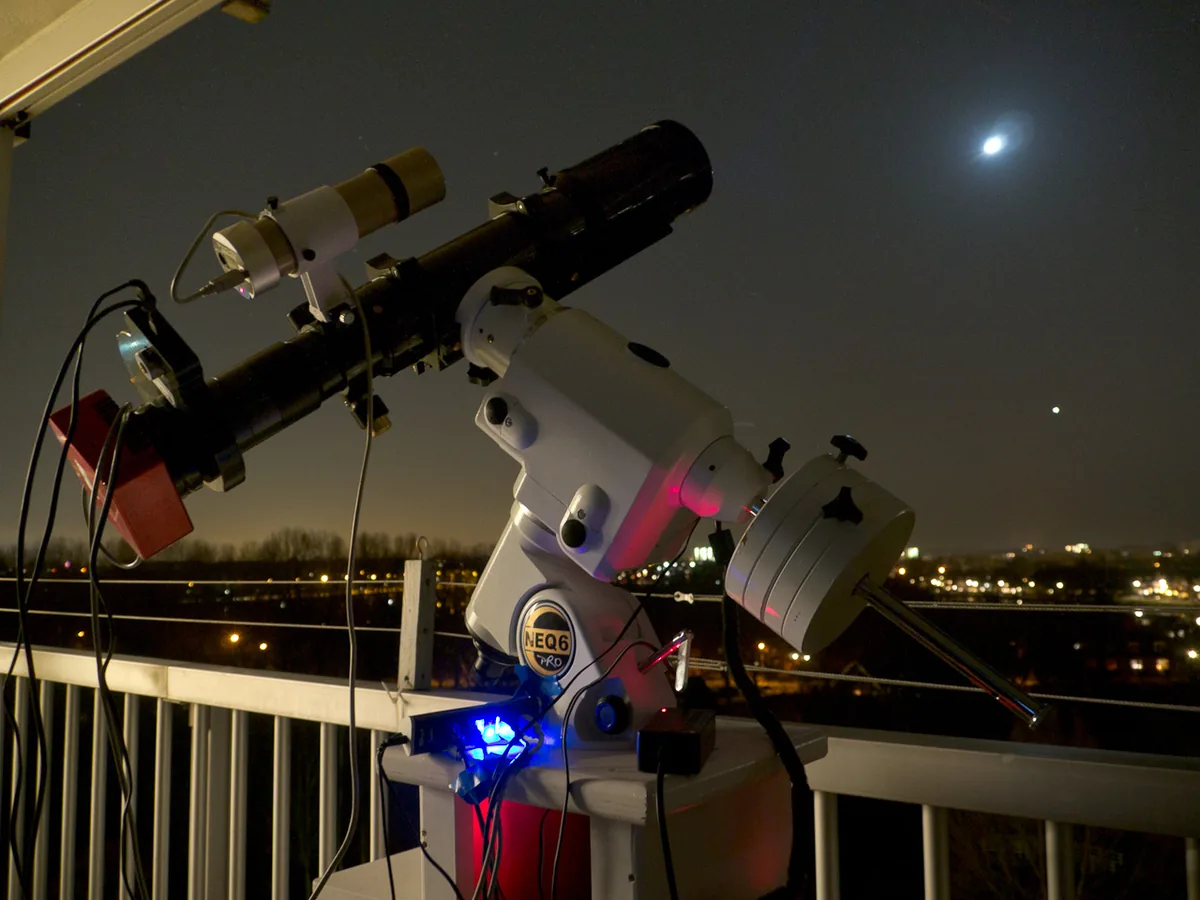
A German equatorial mount (GEM) has motors on both axes, a GoTo database, a dovetail saddle for telescopes, and much more load capacity. Traditional worm-gear GEMs such as the HEQ5 Pro and EQ6-R Pro use counterweights to balance the load. Newer strain-wave (harmonic drive) mounts such as the ZWO AM3 and AM5N can run without counterweights for most amateur payloads.
The practical additions are:
- Payload headroom for a telescope, guide scope, guide camera, filter wheel, focuser motor and dew heaters.
- Dual-axis autoguiding, so declination drift from imperfect polar alignment is corrected too.
- GoTo and plate solving, which let capture software such as N.I.N.A. or an ASIAIR center a target to within a few pixels and return to it night after night.
- Computer control for automated sequences, dithering, meridian flips and mosaics.
Star tracker vs equatorial mount: comparison table
| Star tracker (SA 2i, SkyGuider Pro) | Hybrid tracker (SA GTi) | Worm-gear GEM (HEQ5 Pro, EQ6-R Pro) | Strain-wave mount (ZWO AM3, AM5N) | |
|---|---|---|---|---|
| Rated payload | 5 kg | 5 kg | 13.7 kg (HEQ5 Pro); 20 kg (EQ6-R Pro) | 8 kg / 13 kg with counterweight (AM3); 15 kg / 20 kg with counterweight (AM5N) |
| Mount head weight | About 1 kg | About 2.6 kg | About 10 kg (HEQ5 Pro); about 15 kg (EQ6-R Pro) | 3.9 kg (AM3); 5.5 kg (AM5N) |
| Motorized axes | RA only | RA and Dec | RA and Dec | RA and Dec |
| GoTo | No | Yes (app) | Yes (hand controller, app or PC) | Yes (app or PC) |
| Autoguiding | RA only | RA and Dec | RA and Dec | RA and Dec (recommended) |
| Counterweights | Optional (for heavier lenses) | Included | Required | Optional on AM3 and AM5N under rated no-counterweight load |
| Comfortable focal length | 14-200mm lenses | Up to roughly 300-400mm small refractors | Small to mid refractors, Newtonians, SCTs with reducers | Refractors, small RCs and SCTs |
| Power | AA, USB or built-in battery | 8 AA or 12V DC | 12V DC | 12V DC |
| Budget tier | Starter | Starter to Mid | Mid to Advanced | Mid to Advanced |
Payload figures are the manufacturers’ maximum ratings. For imaging, most experienced users plan to stay well below the rating, often around half to two-thirds of it, because a mount near its limit tracks and guides poorly, especially in wind.
Why focal length is the real dividing line
Tracking error that is invisible at 24mm becomes a streak at 400mm. The useful way to think about it is image scale, the sky angle each pixel covers:
Image scale (arcsec/pixel) = 206.265 × pixel size (µm) ÷ focal length (mm)
A camera with 3.76 µm pixels on a 50mm lens covers about 15.5 arcseconds per pixel, so a tracker can drift several arcseconds without visible trailing. The same sensor on a 400mm telescope covers about 1.9 arcseconds per pixel, and a few arcseconds of periodic error or drift shows up as elongated stars.
Typical practice looks like this:
- 14-50mm: any polar-aligned tracker will deliver multi-minute subs. This is the Milky Way and constellation range covered in our guide to photographing the Milky Way.
- 85-135mm: still very comfortable on a tracker with careful polar alignment and balance. Subs of 1-3 minutes are common.
- 200mm: the practical ceiling for most single-axis trackers. Expect to throw away some subs, keep exposures shorter, and work harder on balance.
- 300mm and longer: this is where a guided, dual-axis mount pays for itself. The SA GTi can manage small refractors here, but a GEM or strain-wave mount gives much more margin.
Payload: add up everything, not just the camera
Beginners often check the camera and lens weight against the 5 kg rating and stop there. Add the ball head or declination bracket, the lens collar, a dew heater strap, a guide scope and guide camera if you add them, cables, and the counterweight if your tracker needs one. A full-frame camera with a 135mm prime is well within tracker limits. A 60-70mm refractor with a flattener, camera, guide scope and guide camera is right at the edge of a tracker’s real-world capacity, and a 80mm refractor imaging train with a filter wheel belongs on an equatorial mount.
Balance matters as much as weight. Trackers with a declination bracket and counterweight track noticeably better when the load is balanced in RA with a very slight east-heavy bias, the same principle used on full-size mounts.
Guiding: single-axis vs dual-axis
Autoguiding uses a small guide camera to watch a star and send correction pulses to the mount. On a single-axis tracker like the Star Adventurer 2i, PHD2 can only correct RA. That helps with periodic error and wind, but declination drift from imperfect polar alignment remains, so polar alignment still has to be very good. If you have not yet dialed in your process, our polar alignment guide covers polar scopes, SharpCap, N.I.N.A. and drift methods.
On a dual-axis mount, PHD2 corrects both axes, uses the Guiding Assistant to measure backlash and polar alignment error, and coordinates dithering with your capture software. For a step-by-step setup see our PHD2 guiding tutorial. Strain-wave mounts in particular are designed to be guided: ZWO specifies periodic error under ±15 arcseconds for the AM3 and under ±10 arcseconds for the AM5N, which is larger than a well-tuned premium worm-gear mount but changes in a way guiding handles well.
Portability and setup time
This is where trackers win outright. A Star Adventurer 2i or SkyGuider Pro, a ball head and a sturdy photo tripod fit in a carry-on and set up in ten minutes. That matters for travel, for hiking to a dark sky, and for those short Midwest windows when a front clears out at 11 PM and the clouds are back by 2 AM.
An EQ6-R Pro mount head alone weighs about 15 kg before the tripod and two 5 kg counterweights. The HEQ5 Pro head is around 10 kg. Strain-wave mounts closed much of that gap: the AM5N head is 5.5 kg and needs no counterweight under its 15 kg reference load, which is why they have become popular with people who image from a driveway or carry gear to a site.
Cold also affects the decision. Trackers running on AA cells lose capacity quickly below freezing; lithium AA batteries or a USB power bank in an inside pocket help. Mounts on 12V power are easier to keep running all night in winter, though cables stiffen and grease thickens in serious cold. Check each product’s rated operating temperature: Sky-Watcher lists 0 to 40°C for the Star Adventurer 2i and -10 to 50°C for the GTi, iOptron lists -10 to 40°C for the SkyGuider Pro, and ZWO lists -15 to 40°C for the AM3.
When to upgrade: the clear signs
You have outgrown a tracker when several of these are true:
- You keep buying longer lenses. If 200mm feels short and you want galaxies and small nebulae, you need more focal length than a tracker handles comfortably.
- You are discarding a large share of subs to trailing even with good polar alignment and balance.
- Finding targets by hand eats your clear-sky time. GoTo plus plate solving turns twenty minutes of star-hopping into a one-minute slew and center.
- You want multi-night projects. Returning to an exact framing on night two or three is easy with plate solving and very hard without it.
- You are adding a guide scope, filter wheel or cooled camera. Each adds weight and cables, and the payload rating disappears quickly. Our comparison of a dedicated astro camera vs a DSLR explains when that camera upgrade makes sense.
- You want automation. Sequences, dithering, autofocus and meridian flips need a computer-controlled, dual-axis mount.
If only the first one or two apply, a hybrid like the Star Adventurer GTi is a reasonable middle step: GoTo, dual-axis guiding and the same 5 kg rating in a mount you can still carry easily.
Which mount to choose by goal
Wide-field Milky Way, nightscapes and constellations
A single-axis tracker. The Sky-Watcher Star Adventurer 2i and iOptron SkyGuider Pro are the long-running standards. Both offer half-sidereal speed for blending sky and foreground. Pair either with a sturdy tripod; a flimsy tripod wastes a good tracker.
Large nebulae and lens-based deep sky (85-300mm)
A tracker for the shorter end, or the Star Adventurer GTi if you want GoTo, guiding on both axes and a small refractor option.
Small telescopes and a first guided rig
A worm-gear GEM such as the Sky-Watcher HEQ5 Pro or a portable strain-wave mount such as the ZWO AM3. The HEQ5 family has a long track record and huge community knowledge; the AM3 is far lighter and needs no counterweights for loads under 8 kg.
Heavier refractors, SCTs and long-term growth
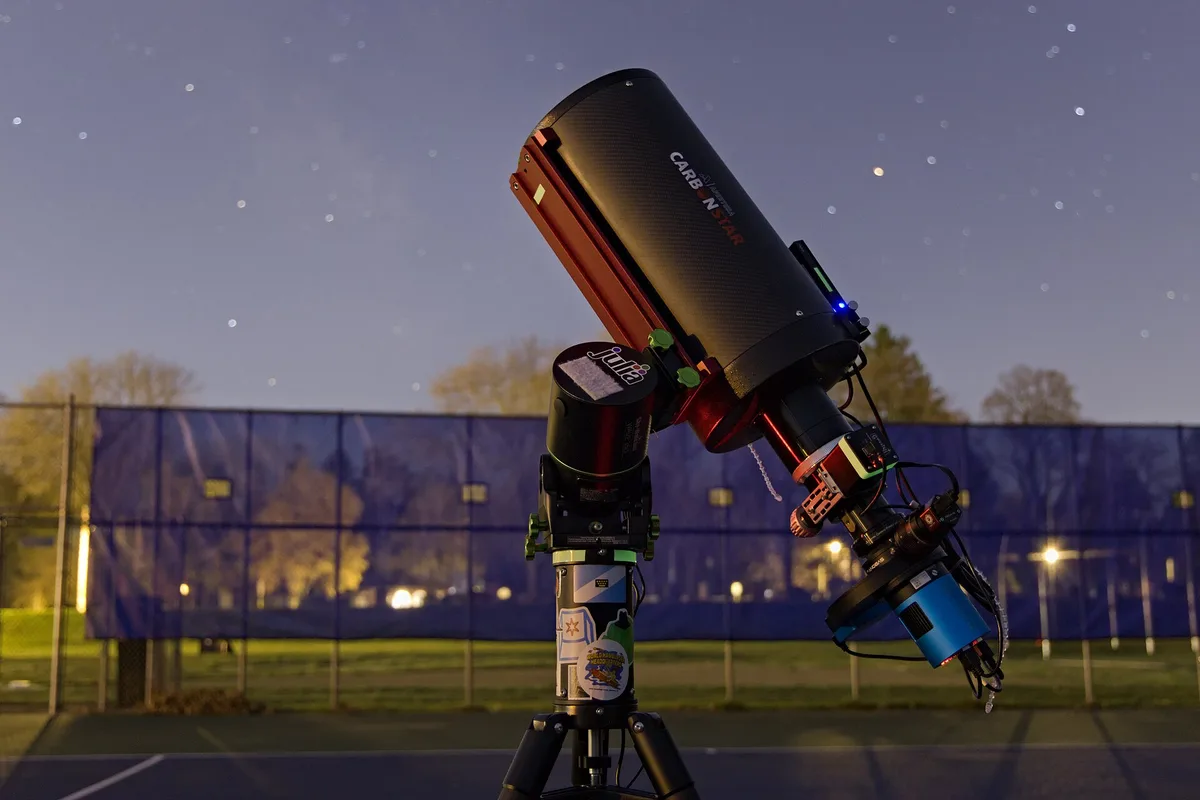
The Sky-Watcher EQ6-R Pro or ZWO AM5N. Both handle a typical 80-120mm refractor imaging train with room to spare. The EQ6-R is heavier but very rigid; the AM5N is portable and counterweight-free for most setups but must be guided for long subs.
Common mistakes when choosing
- Buying to the rated payload. Plan for real headroom, not the number on the box.
- Ignoring the tripod. A heavy mount on a light tripod vibrates. Trackers on light tripods vibrate even more.
- Expecting a tracker to replace a mount. A tracker with a 400mm telescope can work on a calm night, but it is a constant fight.
- Skipping guiding on a strain-wave mount. These mounts are excellent when guided; unguided, their periodic error limits sub length at longer focal lengths.
- Forgetting the computer. A GoTo mount is only half the upgrade. Capture software, plate solving and guiding are what make it efficient. Our astrophotography for beginners guide walks through the whole progression by budget tier.
Frequently asked questions
A small, light refractor, yes, if the total load is well under the tracker's 5 kg rating and the setup is balanced. Most trackers cannot slew or guide in declination, so a dual-axis mount is a much better platform once a telescope, guide scope and astro camera are involved.
Most people find 200mm is the practical ceiling for single-axis trackers, with careful polar alignment, good balance and shorter subs. Wide and normal lenses up to about 135mm are easy. Above 300mm, a guided equatorial mount is the better tool.
It is both: a portable equatorial mount with motors on both axes, GoTo through the SynScan Pro app and dual-axis guiding, but with the same 5 kg payload rating as single-axis trackers. It sits between a tracker and a full-size GEM.
Not for wide-field work. Guiding a tracker helps at 135-200mm and in wind, but single-axis trackers can only correct RA, so polar alignment still has to be accurate. Dual-axis guiding on an equatorial mount is far more effective.
Strain-wave mounts like the ZWO AM3 and AM5N are lighter and usually need no counterweights, but have larger periodic error and should be guided. Worm-gear mounts like the HEQ5 Pro and EQ6-R Pro are heavier, need counterweights and are well understood, with lots of community tuning advice.
A common rule of thumb is to keep the imaging load at about half to two-thirds of the manufacturer's rated payload. Mounts near their limit track and guide worse, especially in wind and with long, unbalanced imaging trains.